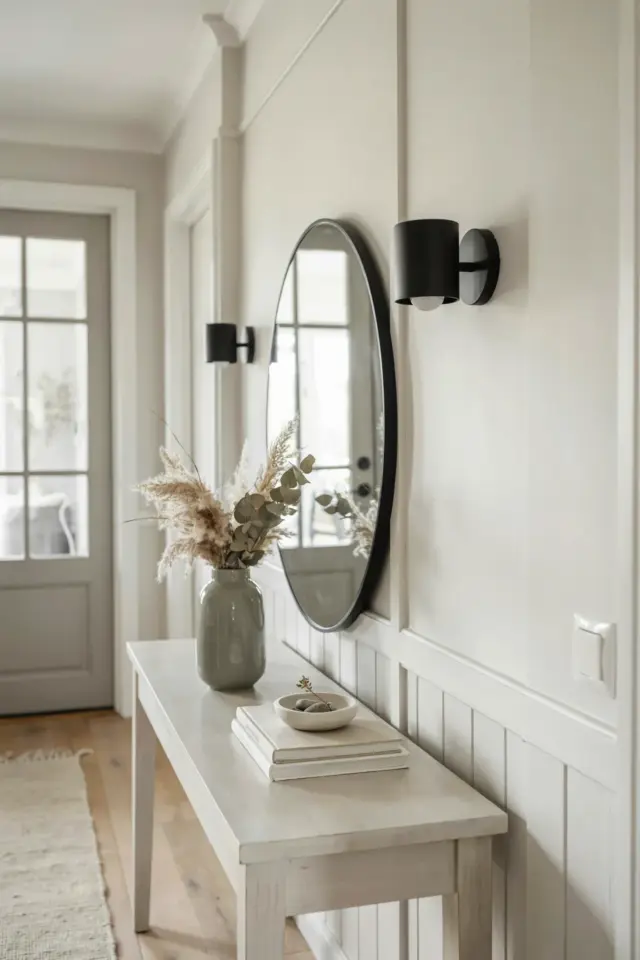
Our hallway used to be the place light went to die. A single overhead fixture threw harsh shadows on the farmhouse walls, and every time I walked upstairs at night, the whole space felt flat and forgotten. That changed the day I hung a vintage wall sconce with an arched arm and an antique brass finish near the bottom of the stairs. Now it throws a warm, cozy glow across the paneling, and honestly, I catch myself lingering on the landing just to look at it.
The best part? This wasn’t a lucky antique mall find or a pricey designer piece. I hunted for a brass sconce for weeks, comparing shapes, sizes, and finishes from every online source I could find. I finally landed on a model that looks like it has been part of the house for fifty years, and the process taught me a ton about what actually works in a farmhouse hallway. Here is the step-by-step guide to finding and installing your own vintage-style wall sconce, plus the specific things you should look for before you buy.
## Choosing the Right Vintage Wall Sconce Style for a Narrow Hallway
The first thing I learned is that hallway lighting ideas fail when the fixture sticks out too far. A sconce that protrudes twelve inches into a four-foot-wide corridor becomes a shoulder magnet. Look for an arched arm sconce that keeps the bulb close to the wall, usually within six to eight inches. That arch still gives you the vintage silhouette without turning your hallway into an obstacle course.
Also consider the backplate. Farmhouse decor loves a rounded, scalloped, or shield-shaped backplate because it reads as old and handcrafted. Flat and square plates feel more modern, and they tend to clash with the rustic texture of shiplap or beadboard. I went with a round plate that has a subtle ribbed detail, and it anchors the fixture nicely against our vertical wall boards.
## How to Match a Brass Sconce to Your Existing Farmhouse Decor
Here is the thing about brass: not all brass is created equal. A polished, mirror-like gold finish screams 1980s, but an antique brass finish with darker undertones and a slight patina feels like it has been there forever. Look for terms like “aged brass,” “unlacquered brass,” or “oil-rubbed bronze with brass highlights” if you want that genuine vintage vibe.
I held my sconce up against three different wall colors before committing. It looked good against warm white, decent against sage green, and absolutely perfect against a soft creamy buttermilk. The lesson is that the same brass sconce can look completely different depending on what is behind it. Grab a piece of cardboard, paint it the same color as your wall, and mount the sconce to that before you drill into anything.
## Easy Placement Tricks for Hallway Lighting by the Stairs
Where you mount the sconce matters just as much as the fixture itself. For a stairwell, the general rule is to mount it at eye level, which usually lands around sixty to sixty-six inches from the floor. But here is a practical twist: if you have a staircase, aim for the height of the average person’s shoulder when they are walking down. That puts the light right in their peripheral vision without glaring.
Another trick is to center the sconce over the landing or at the spot where the stairs turn. A single brass sconce placed near the stair rail creates a beautiful pool of light that guides the eye upward. I added one on the wall beside the bottom step, and at night it casts a soft arc that makes the hallway look settled and inviting.
– Avoid placing sconces directly opposite each other.
– Use dimmer switches to control the glow.
– Position the wall sconce at least six inches from a door frame.
– Match the height of the sconce to the height of your wall art.
– Keep the bulb exposed if you want the vintage filament look.
## The Right Bulb Makes the Warm Glow Happen
You can buy the perfect brass sconce and ruin the whole effect with a bulb that is too harsh. I tested three options: a standard LED, a frosted globe, and a clear vintage Edison bulb. The Edison bulb won, no contest. It throws that amber, candle-like light that makes farmhouse walls look softer and richer.
Pay attention to the color temperature. Look for bulbs labeled 2200K to 2700K, because that range is the golden zone for warm glowing light straight out of the box. Anything above 3000K starts to look clinical, and that is the opposite of what you want in a hallway. I also recommend a filament bulb with a slight tint, because it looks gorgeous even when the sconce is off.
## Step-by-Step Installation for a Vintage Wall Sconce on Plaster or Drywall
Ok so I am not an electrician, and I will be honest about that. But mounting a wall sconce is a completely reasonable DIY if you have a basic understanding of wiring. I turned off the power at the breaker, used a voltage tester to double-check, and then carefully connected the wires with wire nuts before tucking them into the electrical box. Not gonna lie, I triple-checked that tester.
If you are mounting on plaster walls, you need a different approach than drywall. Plaster is brittle, so drilling straight in can crack it. I used a masonry bit to go through the plaster, then drove a toggle bolt into the hollow space behind it. For the top screw hole, I simply used a heavy-duty anchor, which worked fine since the sconce is lightweight.
## How to Hide Cords if You Do Not Have a Junction Box
Maybe you love the look of a vintage wall sconce but your hallway has no wiring near the staircase. I have been there, and there is a good solution. Grab a plug-in sconce kit, which lets you attach the sconce to the wall and run a cord down to an outlet. This makes the whole thing look hardwired if you use a cord cover painted the same color as your wall.
Here’s a weird little aside: I spent a ridiculous amount of time painting a cord cover to match our trim, and then I realized the outlet was on the other side of the stairs. I had to run the cord along the baseboard for four extra feet. It still looks clean, but the moral of the story is to measure your outlet distance before you buy anything.
## Styling the Area Around the Sconce to Finish the Look
Once the sconce is up, resist the urge to clutter the area directly beneath it. The whole point of a wall sconce is to create breathing room, so keep the space around it simple. I have a small wooden stool tucked nearby, but I kept it empty because the light needs room to do its thing.
If you want to add something, go with a single piece of framed art on the opposite wall. A brass sconce pairs beautifully with black-and-white photography or a simple botanical print. Just keep it in proportion. Something too small will get lost in the glow, and something too large will fight the light for attention.
## Why This Hallway Lighting Setup Actually Works at Night
The real test for any farmhouse entryway lighting happens after dark. I turned off the overhead light the first night after installation and just walked the hallway with only the sconce burning. The result caught me off guard. The arched brass arm cast a gentle shadow that stretched along the wall, and the warmth of the bulb made the whole space feel like a reading nook.
Here is the thing that surprised me most. My family now uses the hallway at night more than they did before. The light draws people in a way that a standard overhead never did. It makes the journey from the living room to the bedrooms feel peaceful instead of practical. That is worth more than the cost of the fixture, and it is the reason I keep recommending this approach to anyone who asks about farmhouse entryway ideas.
If you are currently collecting hallway lighting ideas for your own entryway, save this one for later. A vintage wall sconce is not just a pretty object, it is a functional little light source that changes how a space feels every single evening. Take your time picking the right brass finish, measure your space, and do not skip the dimmer switch. Your hallway will thank you.
Leave a Comment