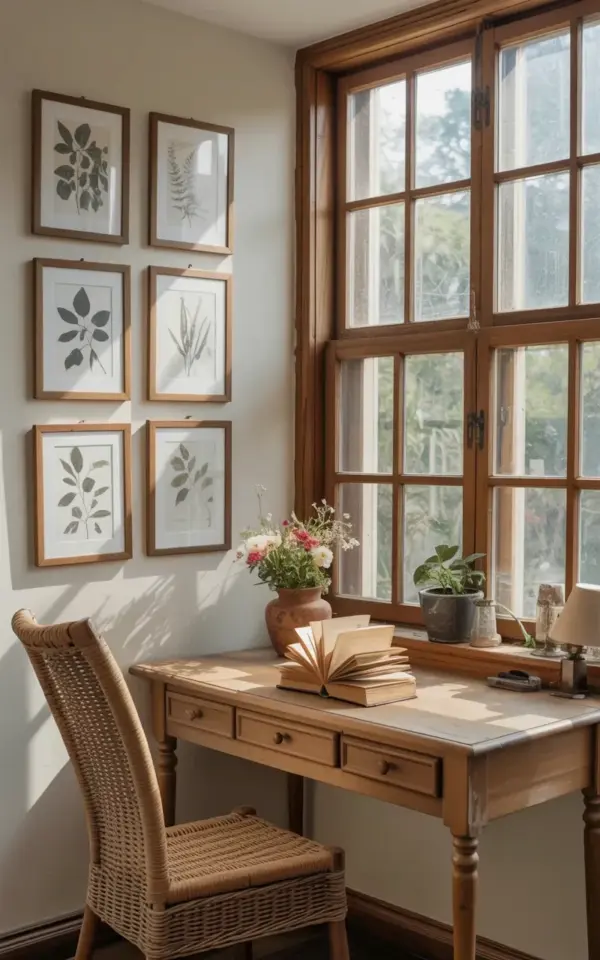
Rain is tapping against the glass in that lazy, hypnotic way that makes you want to cancel all your plans. You’re probably holding a warm mug right now, staring at a corner of your home that just feels like wasted space. Here’s the thing: a cozy spring reading nook doesn’t require a renovation budget or a Pinterest-perfect spare room. Honestly, the photo that inspired this whole post proves it perfectly. A rustic desk tucked under a large window, a neat grid of botanical prints, and an open book catching that soft daylight is all it took to create a mini retreat that practically begs for slow weekends with tea.
This space works because it follows one simple rule: start with the light, not the furniture. That big wooden-framed window with multiple panes is the anchor. The cream-colored wall and natural shadows do the rest of the work. I want to walk you through how to pull this exact vibe together, even if you’re starting from zero. You don’t need to know anything about interior design. You just need to know where you like to sit and what makes your shoulders drop away from your ears.
How to Build a Window Reading Nook in a Small Space
Look, the best reading corner in your home is probably the one with the most natural light. Walk around your house right now and check the windowsills. Which one gets that soft, diffused glow in the afternoon? That’s your spot. The photo shows a classic farmhouse-style setup, but you can adapt the idea to any room. Place a desk or a slim table against the window wall. It doesn’t need to be fancy. The goal is to create a flat surface that catches the light and gives your eyes a place to land.
If you’re renting, don’t panic. You can achieve this with a simple folding table or a sturdy sideboard you already own. Push it right up against the glass, not a foot away. Trust me, the closer to the window, the more connected you feel to the rainy world outside. That connection is half the magic of a cozy nook. It makes the rain feel like a special event rather than an inconvenience.
Choosing the Right Chair or Bench for Long Reading Sessions
You’ve probably noticed the photo doesn’t show a throne-like armchair in front of the desk. That’s a deliberate choice. A small stool or a simple chair pulled up to the desk keeps the space visually open and uncluttered. For real comfort, you want something that lets your feet touch the floor and your back stay straight. A wooden chair with a cushion works wonders. Or, if you have room, a low bench is perfect for leaning back against the wall with a blanket.
Don’t overthink the seating. I’ve read an entire book perched on a wooden stool with a folded sweater as a cushion. Comfort is about the angle of your body and the softness of your seat, not the price tag of the furniture. The key is to test it out for five minutes with a book in your hand. If your neck hurts, grab a pillow. If your knees complain, adjust the height. Your body will tell you what it needs.
Farmhouse Style and Rustic Desk Ideas for Beginners
The rustic desk in the photo is doing some heavy lifting, and I’m not just talking about holding the book. With its turned legs and simple three-drawer structure, it adds that farmhouse feel without screaming “themed.” You can find similar desks at thrift stores, flea markets, or Facebook Marketplace for a bargain. The trick is to look for natural wood tones and simple lines. Avoid anything with too much ornate detailing if you want that classic, understated farmhouse look.
Here’s what I love about this approach: it’s forgiving. A few scratches or a water ring on the desk just adds character. Not gonna lie, I once bought a desk that had gum stuck to the underside. I cleaned it off, gave it a coat of wax, and you’d never know. The slightly imperfect surfaces are what make a reading corner feel lived-in and real. If you have a shiny modern desk, you can still fool the eye by adding a woven placemat or a linen runner to break up the glare and introduce texture.
Decorating With a Botanical Print Grid Pattern
Let’s talk about that wall art arrangement because it’s the unsung hero of this whole nook. Six botanical prints in a neat grid pattern create an instant gallery feel with zero effort. You don’t need to match frames perfectly; in fact, a mix of similar but not identical frames looks more collected and authentic. The key is the grid format. It gives the wall structure and keeps the eye moving in a smooth line. It’s the kind of pattern that feels calming to look at while you’re lost in a thought.
How do you hang a grid without a laser level and a meltdown? Start with paper templates taped to the wall. Cut squares of paper to the exact frame size and arrange them until you’re happy. When the spacing between each print is consistent, usually about two to three inches depending on the frame size, use a pencil to mark the nail holes. If you want an even easier path, use a frame already pre-wired with a hanging kit, which saves you an entire afternoon of frustration.
Blending Botanical Decor and Terracotta Accents for Spring
Spring arrives in this nook through the smallest details. That little terracotta vase with pink and white flowers on the desk is a textbook example of less-is-more. You can pick up a terracotta pot at any garden center for a few dollars. Or maybe you have one sitting in a shed with a dead succulent in it, like I did. Clean it out, scrub the white mineral stains, and you have a perfect vase for a handful of grocery store tulips or ranunculus.
The botanical prints echo the theme without making the room feel like a jungle. Blending botanical decor means repeating a motif without overloading the senses. Say you have a fern print on the wall. Add a real fern plant or a eucalyptus stem in the vase. The combination creates a dialogue between the art and the actual plants, making the space feel alive. And when it’s raining, those pink flowers against the soft gray light are just perfection.
Simple Styling Details to Make Your Reading Corner Instagram-Worthy
You have the desk, the chair, and the wall art. Now it’s time for the finishing touches that make this a genuine cozy spring reading nook. An open book on the desk is more than a prop; it’s an invitation. If you’re actually using the space, which you should be, the open book is where you left off during your last session. The pages catch the natural daylight, and the physical object warms up the whole composition.
– Layer a woven rattan chair pad or a chunky knit throw over the seat for immediate texture and comfort.
– Keep a stack of books on the corner of the desk with a small ceramic mug holding your reading glasses and pens.
– Add a candle with a floral or fresh scent like lilac or rain, but only light it when you’re actually sitting down.
– Place a small bowl of peanuts or a pretty tray with a teapot nearby for lazy afternoons when you refuse to get up.
– Tuck a pair of thick socks or slippers under the desk, so you’re always ready for a chilly afternoon.
The goal here is to set a stage that you actually want to sit in. Don’t decorate it like a museum display. Leave a bookmark, a receipt, or a pressed leaf between the pages. Make it a place that looks like it’s used. Because, and here’s the honest truth, a perfect reading nook that never gets used is just a dust collection station. I’ve been guilty of this myself, creating a gorgeous corner and then reading on my phone in bed instead. This season, I’m calling myself out. If you can see the nook, you sit in it.
Wrapping Up Your Cozy Nook Refresh
You can build this exact farmhouse-style nook over a weekend, even with zero prior design experience. Start with the window and natural light, add a simple rustic desk, hang the botanical prints in a grid, and finish with a few terracotta and floral touches. It honestly comes down to elements you probably already have or can thrift for under fifty bucks. No pressure, no perfection, just a welcoming spot for you, a book, and the sound of rain on the glass.
So save this for your next corner refresh, grab a photo of your own window, and start moving things around. Your future rainy afternoons will thank you. Let me know in the comments, what’s the first book you’re planning to read in your new nook?
Leave a Comment